A reflection on Muslim and Jewish centred workshops centering care, resilience and resistance
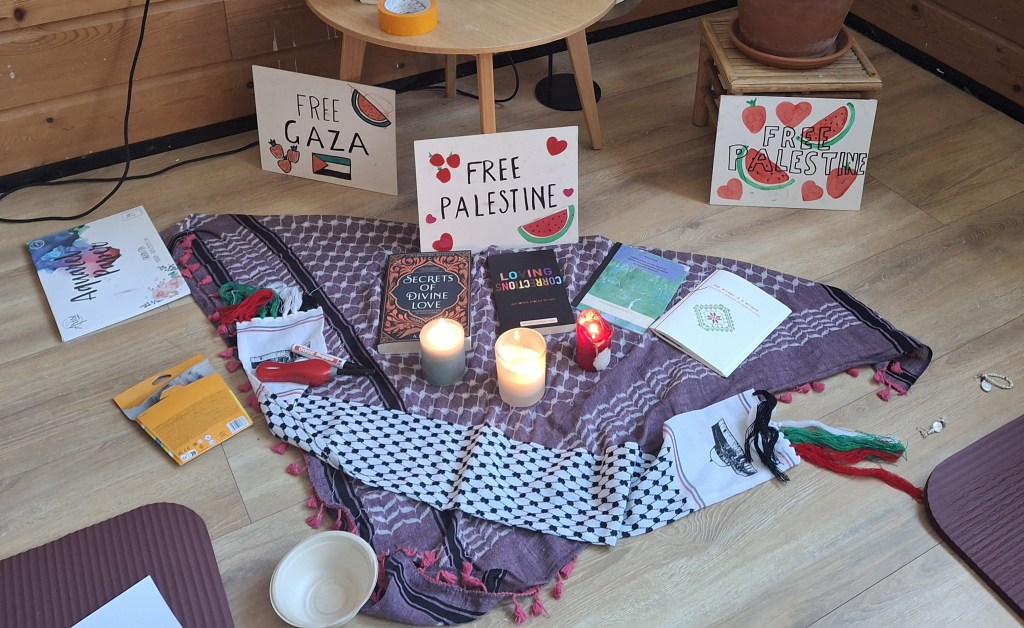
I organise a series of Community Care Days. This is open to anyone aligned with Palestinian liberation, but centred on Muslim and Jewish folks; as our identities are pitted against each other to serve colonial and Zionist agendas. This is a space to disrupt and reject the false narratives increasingly perpetuated by state and media apparatuses that Jewish and Muslim folks are historic and ‘natural’ enemies. It aims to refuse and reject the Zionist narratives through our joy, rest and building solidarity. This is also space to think about what we need- to stay activated and engaged in movements towards collective liberation. In this space we breathe, yoga, write, chat and eat and drink tea. So far there have been two sessions, and I plan for more.
This is necessarily an anti-Zionist space: This is not a space for folks to unlearn Zionism, as valid and necessary as those spaces are- that takes a specific framing and investment of emotional labour that all participants must consent to. Hence, this is a space for folks who understand that the hyper-acceleration of genocidal violence, occupation and apartheid in Palestine is rooted in colonialism and not religion.
Even if we share a common understanding of Israel as a settler colony it’s important to articulate our truths and communally acknowledge our rejection of the false narratives that uphold Zionism. Even though we come together as allies, our journeys may be wildly different. Our stories need care and attention, what we know and how we know deserves space, and can be fertile ground to help inspire others who are not aligned with our positionalities.
Fundamentally the care day is about the following three things:
A space to reject, refuse false narratives
A space to rest and build resilience
A space to consider how to stay get engaged in struggle and support each other in taking action
On narrative…
In November 2024 the Israeli football team, the Maccabi’s were set to play Amsterdam’s home team Ajax. The fans have a solid reputation of bringing racist fascistic violent behaviour wherever they go. Although warned, Amsterdam’s Mayor Femke Halsema saw no reason to block their visit and protect the citizens of our city. We are talking about greenlighting well known hooligans, many of whom are war criminals in an active genocide, to come to our city in huge numbers.
In the week leading up to the match Amsterdam wasn’t safe. Activist groups on Signal were sending out warnings to not go out alone or hide any sign of solidarity with Palestine. These warnings were sadly on point, as people were being verbally and physically abused for wearing a keffiyeh or being Muslim. Bottles were thrown, hijabs were pulled off, Palestinian flags were torn down and burnt- this was just the warm-up. On the day of the match Maccabi fans gathered in central Amsterdam and were bellowing racist, violent and misogynistic chants on the streets that celebrated the murder of Gazan kids and raping women.
It’s at times like this that Amsterdam feels like one big village and everyone talks. On the evening after the match, and after a week of provocation- there were violent clashes between the Israeli hooligans who armed themselves with wooden sticks and metal bars and local men who responded.
Two local journalists filmed and accurately named the Israeli instigators charging through the streets armed with wooden and metal poles and targeting Dutch people. Predictably though, the narrative circulated globally by the major news outlets including Reuters and the BBC, is that the armed mob were antisemitic locals committing a pogrom! The gall! They didn’t skip a beat in using this as an opportunity to propel Zionist propaganda, even if it utterly undermined professional integrity.
It’s a long timeline of events, and I encourage you to watch this video from Novara Media which cites its sources of references, unlike global and legacy media outlets, which took the opportunity to spread false narratives of an antisemitic pogrom. (Here is a short version). The Novara Media reportage uses footage from the local young youtube journalist Benjamin Buit (known as Bender)- who accurately narrates what he’s filming as he films it. An Amsterdam photographer- Annet de Graaf filmed the Israeli mob and sold her footage to Reuters, believing they would use it to tell the truth about them attacking a Dutch resident. Both of their footage was misused to propagate the lie that Israeli’s were being attacked by mobs of angry Dutch Muslims simply for being Jewish. De Graaf has spoken very publicly about her shock at how her footage has been misused to sell the lie of an antisemetic pogrom.
This misuse of footage was no accident. This was an intentional ‘blunder’ to perpetuate the false narrative that antisemitism predominantly and specifically emanates from Arab and Muslim communities. The lie that this was an antisemitic riot was then parroted by the Dutch King and the President Biden. Femke Halsema (Amsterdam’s Mayor) stirred the pot again, by comparing the event to Kristellnacht, which is beyond insulting and obfuscates any real conversation on actual antisemitism. Here we are in a city where we have the Anne Frank house, where we walk across the metal cobblestones- marking where Jewish people were forcibly removed from their homes to be exterminated and they are perpetuating this myth that lessons have been learned, and there’s no more antisemitism in Europe- except from the local Muslims. The framing of the local Dutch Moroccan population, (a demographic which is often maligned by the way) as motivated by antisemitism and not in retaliation to a week of violent instigation is beyond ridiculous.
Even though Amsterdammers have kept the receipts and Annet de Graaf continued to insist that her footage of violence incriminating the Maccabi hooligans be used properly, a simple google search of the incident still throws up the lie of this being an antisemitic riot. Even though the BBC apologised for their misuse of the footage, the damage is done- that an antisemitic pogrom at the hands of young Muslim men is forged into psyches across the world.
It is obvious that this was a constructed manoeuvre to perpetuate the narrative of Jewish unsafety in Europe, to legitimise Israel whilst they conduct the livestreamed genocide of the Palestinians.
My head explodes and my soul screams.
And we are the ones who have to live with the legacy of this. We are the ones who have to rake out their seeds of division. We are the ones who must deal with the mistrust and the activated nervous systems. We are the ones who must wade through the racist, violent, and islamophobic stereotypes of Muslims and the disturbing use of antisemitic slurs by some of the respondants to the Maccabi violence. It weighs on our minds; it presses on our bodies; it is heavy.
Resilience and Resistance
In the week following the Maccabi violence, local people and activists protested. These protests were violently dispersed by the police. People were beaten, thrown into vans and dropped off in different unknown locations across the city. As a response activists reached into their networks and organised an aftercare workshop. I got in touch and offered my yoga services. That evening five people got together, including one person who attended the protest, and Sheila who founded KABRA, a wellness space for marginalised and politicised identities. I expressed my desire to create a space for Muslim and Jewish folks to get together and refuse the divisive narratives which make us both less safe, and Sheila immediately offered me her new space in Nieuwland to do it. Kismet! A perfect alignment, as KABRA integrates wellness with liberatory politics and aims to nurture resilience in activist communities.
Care is political; who gets access to care is political and how it relates to our resilience in confronting the polycrisis of climate collapse and rising fascism. Care is necessary to not only regulate ourselves but stay in the fight which demands so much physical and mental stamina. We need to stay focused, discerning, curious and kind. We need tools, coping strategies and community- and this is what I mean by ‘care’. Care as community and care as somatic tools and healthy habit formations. In the context of care, Audre Lorde is often quoted by a whole range of people- from the Wellness Capitalist to the radical activist demanding collective liberation:
Caring for myself is not self-indulgence, it is self-preservation, and that is an act of political warfare.
This quote is from her Cancer Journals and is often stripped of the important context of her being a black woman fighting a deadly disease. She was saying that in order to survive, she needed to take care of herself. She needed to survive so she could not only experience life but also stay in the fight. Care- by which I mean, rest and resilience building, are necessary for staying engaged in action. Care is important because it is connected to our ability to act with the time, the body and the attention we have. It can also help us be mindful that how we show up will change over time and with our changing circumstances. Another important Audre Lorde quote that should be held alongside her famous self care quote is:
To refuse to participate in the shaping of our future is to give up. Do not be misled into passivity either by false security (they don’t mean me) or by despair (there’s nothing we can do). Each of us must find our work and do it.
Sometimes we need community and rest to ‘find our work and do it.’ Sometimes we need to be inspired by others to keep doing the work. In these times of polycrisis we need imagination to fight for a different world, to not give up on the future, to shape the world in the way we want and need. To refuse having our future written for us takes resilience, and resilience as a refusal of passivity and despair.
The first two sessions
The first two sessions were really lovely but poorly attended. In the first session, only four people turned up, yet we had a rich conversation about activism and finding our role in the struggle for collective liberation:
One person who attended, X, was deeply engaged in frontline activism, including putting their body on the line and facing police aggression. They spoke about the whole wave of background support which is needed and necessary for them to remain on the front line. Another participant, J, stated that due to their chronic illness, they were unable to be present at marches and the frontline, but instead helps an activist friend who is engaged in a more visible frontline resistance.
Another person, H, wanted to reach out to fellow Jewish folk who were anti-genocide and occupation, but not necessarily anti-Zionist. X, -the person deeply engaged in frontline struggle, said that they would rather have their head kicked in by the police than debate Zionists! As disparate as these positions are they both needed and necessary; we need activists and actionists engaged in direct action. We also need to change the hearts and minds of people who have been brainwashed into accepting colonial norms like Zionism, through connection and patiently planting seeds. Each of us must find our work and do it.
I asked the group what they would like in the future, and the responses were in favour of more bodywork, pranayama (breathing exercises), and a greater focus on religious and cultural traditions and wisdom.
I stayed in contact with H who wanted to strategise on creating a space for Jewish folk to unlearn Zionism. In one of our conversations they asked me why the Care Day, is specifically a Muslim and Jewish space? This was a really helpful question, which made me think- what makes this centred on Muslim and Jewish identities, apart from the fact that we are sitting in a room together? In the following months I met with more antizionist Jews at a shabbat meal hosted by and for members of the antizionist group Erev Rav. Someone there told me that they hadn’t attended because they felt the space wasn’t declared as anti-Zionist enough. This is the rub, because in that conversation I realised, I had made my anti-Zionist position clear, but only on the fifth slide of my Instagram reel. There was a part of me that wanted to attract people who were questioning and unravelling their understanding of Israel and Palestine. I wanted to trap them with honey, with the hope of de-radicalising them with pranayamas and tea! Joking aside it crystallised what the space should be right now and made it clear that unlearning Zionism is fundamentally a different space to what this can provide.
The second session focused more on spirituality and considered how can we draw from our lineages to give us strength in these times.This felt more cohesive in terms of a theme. I posed the question “what is sacred” which I thought was necessary to ask in these times when basic moral givens such as the sanctity of the life of a child are crushed under the brutal reality of what is happening in Gaza, West Bank, Sudan, Congo, Haiti for example.
I also posed the question ‘does your religious/spiritual/cultural/personal background show up in your political/social values?’ which was important to ask because as Muslims, we are vilified for our identity, despite our deeply rooted sense of duty and community service. And for our Jewish siblings- their religion is articulated as intertwined with Zionism, when actually it is anything but. Its is really interesting to explore the interrelations of how our religious and cultural identities are articulated in the mainstream. This paved the way for a nice conversation. However, I feel that these questions could have gone deeper and, in future workshops, will use practical methodologies (making/creative writing exercises) to explore these themes more.
Future plans
I plan for more workshops as I am affirmed by many folks that this is necessary and needed. I also plan to work in collaboration with others (hopefully some of whom attended the workshop) to form a ‘care collective’. It might be that we always continue to focus on Muslim and Jewish lives, or we may broaden some out to activists in general. The upcoming workshops will centre of one specific theme per workshop, and ask questions like “what is resistance?”
The workshop will also integrate a component of considering acts of resistance or supporting resistance. How can we move from the symbolic to the material- which action can we join? Which activist can we support? Can we spend this time to write to actionists who are imprisoned, such as the Filton18? What other collaborations, knowledges, projects can come out of this?
I know for myself I’ve been inspired by the people who showed up. Through setting this up, I’ve had the chance to get to know members of Erev Rav, and the chats I’ve had with some of their members has catalysed my imagination and inspired me to create other events, by myself and with others.
Inshallah, this is just the beginnng.
 pedagogicalreflections.com
Leave a comment