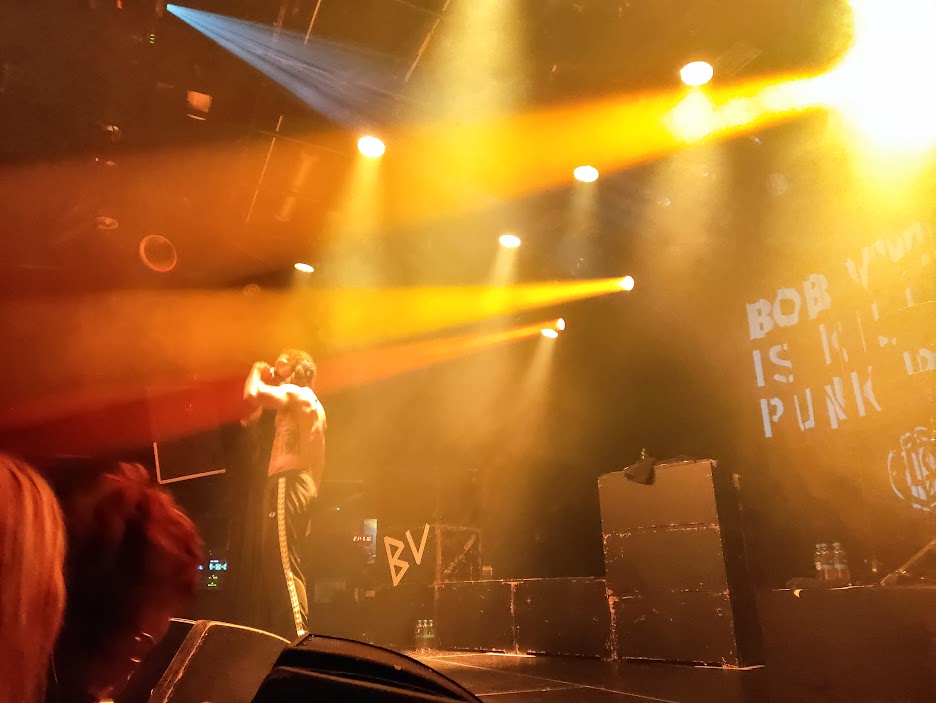
Bob Vylan chanting Death Death to the IDF on live TV was a pedagogical moment that is consistent with who they are as artists. It is a pedagogical opportunity to consider why supposed ‘semantic violence’ (drawing from Mohammed El Kurd) is more reproached and more condemnable than the abject horrors enacted by a genocidal army? Why is there a hysterical over-emphasis of having to prove you are not antisemitic before daring to speak about the reality of the egregious atrocities committed by the IDF? Why has so much weight been attributed to language and discourse whilst no accountability, incursions or repercussions have been faced by the IDF? An entity who continue to commit provable atrocities with not only impunity but collusion by the state and media apparatuses. The veneer of Israel’s ‘moral authority’ has not only cracked but split wide open, and Death Death to the IDF loudly echoes in its chasm making it ever harder to ignore. Yet it’s still a shocker, and we need to reflect, on after all that we have seen, why?
Death Death to the IDF is a pedagogical moment. We expected ruckus around Kneecap, we expected Nadine Shah and countless other artists including Bob Vylan, to say Free Palestine, maybe even a Fuck the IDF. I’m gonna be honest, Death Death to the IDF made me spit out my drink. I did not expect that level of directness. It is circulating worldwide because it bravely says what people have been holding back. And it questions- with all that we have witnessed, why is it controversial? Questioning this cuts through to the colonial logic which demands that the oppressed must prove their humanity through submission and not defiance, to be considered a worthy victim. And we, in solidarity with Palestine must also play the game of nicey nice, lest we’re discredited.
Bobby chanted with full knowledge of the ramifications. This was no outburst, but a considered risk. He didn’t just chant it, he embodied it, with full conviction and force. It moved through the depths of his soul to the crowd and to everyone at home watching. Each iteration more powerful. It was speech as action. To say Free Palestine is stating solidarity, Death Death to the IDF perforated the permissibility of what we can say out loud. It was a historic moment.
Bobby/ie knew full well that this would be circulated worldwide with material repercussions to their ability to perform future gigs. They understand the system and yet refused to obey the rules. They did it to stay true to their art and true to their message. It’s in their lyrics, look it up. Apart from releasing banger after banger (seriously have you listened to We Don’t Care), Bob Vylan is invested in their art as education. And as someone who often thinks about education, I have often considered the pedagogical value of their songs. They’re not only redefining the sound of punk in a deliriously powerful way, but their lyrics also refer to social and political history, offer guidance and incisively document the moment we are in. They are what we need from punk.
I am not surprised that the day after the chant, Bobby wrote a post about the necessity of educating the next generation. Education was always core to their art. Their song Health is Wealth literally encourages people to take care of their bodies, as the revolution is real. It starts off with lyrics that are devastatingly on-point:
The state need not kill those that killing themselves
Don’t make it an easy job for ’em
The killing of kids with £2 chicken and chips
Is a tactic of war, waged on the poor
Can’t save wages on slave wages
And you don’t think fresh fruit with your face on the floor
The whole song speaks to how poverty leads to the overconsumption of low-quality foods that kill us. And invites an awareness of how food impacts the body- with the message that we need to be strong and resilient to be ready to dismantle injustice. Most of their songs are either catharsis or encouraging us to get up and fight. It powerfully gestures towards the causes and the soul crushing effects of late stage capitalism.
In 2008-2011, I worked for an education provider that delivered digital multimedia courses aimed at 15–17-year-olds considered ‘at risk’. I ran the schools programme and worked with young people from schools all over Southeast London. I wish I could have played Health is Wealth to my yoots then, most of whom were POC boys. I don’t know if I would’ve succeeded in prying them off the Haribo and Monster drinks (also, they are teenagers), but perhaps it would’ve given them catharsis and guidance. The financial ‘crisis’ and David Cameron’s austerity policies were devastating at this time. During the three years I worked there, we witnessed the closure not only of youth clubs, but youth hostels for homeless teenagers, and the defunding of anti-knife crime organisations that were community led and making progress in getting young people out of gangs. And the young people felt this. They felt this lack of care, this being discarded- they understood that the state facilitated desperation and don’t care enough about their lives…. The state need not kill those who are killing themselves. Bob Vylan formed after seven years of these policies started impacting our way of life, our access to food, housing and healthcare:
Yeah, the BBC are talking ’bout the GDP
That means fuck all to me
I gotta eat
In my role as the Schools Programme Manager, politics was often on the table, and we talked about systemic injustice like racist policing. I often slid the topic of dissent into the conversation and played them Mos Def’s A New World Water and (I know this is cheesy) Rage Against the Machine’s Killing in the name of.. Of course, I was then 30 years old, a dinosaur in their eyes and this was considered as either lame or trying too hard. I wish I had Bob Vylan back then- a strong example of positive masculinity, unapologetically Black (black man shine, completing my goals on black man time) and infusing rage with liberation. In the mid-late 2000s the music my cohorts of young people listened to was alllll about Grime. Now, don’t get me wrong, Grime is not a crime- but my engagement with Grime is surface level, because I am generation X. Going to see Dizzee, Skepta and Stormzy in venues and festivals doesn’t make me deep into the music, I have love and appreciation from afar as an older being. That said, what I missed from Grime, from my surface level engagement- was a political project that was more than pointing out systemic oppression (which of course has inherent value that shouldn’t be undermined). I missed the Rasta influence of Jungle in my youth which infused dubby bass with messages about unity and self-respect. And this is why I love Bob Vylan, because political agency is at the front and centre of their music. And actually, I love them because they blend the pointedness of Grime with the revolutionary vision of Reggae and Jungle. Take for example the track Walter Speaks. This is an extract of Walter Rodney, the anti-colonial activist and scholar from Guyana. He’s most notably known for How Europe Underdeveloped Africa. The Price of Life Album begins with an excerpt of him speaking:
Economic crisis can always be measured in terms of statistical indices
But more important still, people in their day-to-day lives, will know what it means to be living in a state of economic crisis
This is followed by the massive choon (and my number to pump iron to)- Wicked and Bad, which literally describes the day-to-day state of living in an economic crisis in relatable terms:
Rent on the rise, you can’t afford it
Baby need new clothes, told your lady that you’ll sort it
I mean- this is reminiscent of Paolo Freire’s Pedagogy of the Oppressed– to encourage your learners to connect their lived experience and the oppressions they face with wider socio-economic structures, grounded in interrogating coloniality. This is the foundation of developing a conscientizacao, or a critical consciousness. Coupled with wisdom on maintaining health and dignity against the cruelty of late-stage capitalism. Boom. Great material for classroom learning!
So, I’m thinking about the pedagogy of the chant. Bobby/ie took the opportunity of an international stage with global circulation in legacy and online media, to move the dial from Free Palestine to Death Death to the IDF. As much as we should always say Free Palestine, it does not name the oppressor. For almost two years the BBC, Guardian etc etc etc times infinity etc have consistently under-reported and used pathetically passive framing in their reporting of the genocide. The egregious brutality of genocide is couched in words like tragedy or human catastrophe, or that people died. This systemically renders the actions of the IDF invisible. The genocidal death machine is spoken of as moral, justified yet with a few crazy exceptions. Their actual savagery- which we have all too many gruesome and soul-destroying receipts for, is at best equated to the people who are fighting it. Hence it is up to us, us- who are in solidarity with Palestine, to name the oppressor with passion and not deference to the colonial logic that demands semantic obedience. I ask, why is it a risk to say Death Death to the IDF and not death to the Nazis or ISIS? I’m thinking about Mohammed El Kurd:
We understand from a young age, as Palestinians the semantic violence we supposedly practice with our words dwarfs the decades of systemic and material violence enacted against us by the self-proclaimed “Jewish State.” A drone is one thing, but a trope—a trope is unacceptable. We learn to internalize the muzzle. (Perfect Victims, p101)
Semantic violence for Palestinians is twofold- not only must the Palestinian tread carefully to not provoke the anger of the oppressor with the boot on their neck, thus ‘internalise the muzzle’; but they are again victims of semantic violence because their history is reduced to the question of their sovereignty, and their pain is always interrupted by the assumption of their guilt.
I’m thinking about how the Zionist ‘historian’ Joan Peters claimed that Palestinians were non-indigenous recent migrants from other Arab lands in her book From Time Immemorial (1984). This facetious proposition and its high currency framed Palestinian identity and sovereignty through its negation in academic discourse and media circles in the Global North. Palestine emerges not in and of itself, but through the questioning of its very existence. The question of Palestine, rather than the reality of Palestine. And from this, this starting on the back foot, proving Palestinians were there, that they cultivated the land, that their humanity is worth the same as a Western subject- is the ground which fertilizes the semantic violence. The “I know you stole my house and killed my father but let me first centre you. Let me absolve myself of antisemitism.” This casual sidestep of Palestinian indigeneity in favour of questioning Palestinian rights is everywhere. It’s the same casual sidestep of Palestinian grief and pain, to first demand that they prove they are worthy subjects of mourning. (Please read Mohammed El Kurd’s Perfect Victims, because he says this all better than I do).
Death Death to the IDF doesn’t obey the semantic disciplining. It’s refuses. I’m thinking now of the Anishnaabeg scholar and artist Leanne Betasamosake Simpson and her colonial refusal. That is, refusing to emerge in the political or semantic framework that the colonial order insists we must exist in. Refusing to decentre indigenous intelligence and world making, to be credible, believable, relatable for western epistemologies and institutions. Refusing to play the game and avoid the traps set before her and her people, that render them savage and uncultured. Her generative refusal is in her writing and teaching practice that centre Nishnaabeg knowledge and values rather than arguing for their acceptability in colonizer epistemologies. Please read As We Have Always Done (2017).
Death Death to the IDF and its reaction is an education on how we, us in solidarity with Palestine, have also obeyed the colonial logic of fearing to commit semantic violence by being too direct and instead wafting around in language to sanitize and legitimize Palestinians. Without even daring to speak to their right to resist. Going back to Mohammed el Kurd:
The most comical and the most frustratingly heartbreaking thing about the Palestinian struggle is that there is so much time and energy and effort attributed to language, to what we call them and what we say about them and our feelings towards them, whereas their bombs and their handcuffs and their boots and batons and tear gas is rarely afforded any language.
Death Death to the IDF, doesn’t play the rules of this language game that Kurd outlines, it’s concise as fuck. It refuses the imperative to (again in Mohammed el Kurd’s words) become ‘defanged’ to be considered credible. It doesn’t play nice. It doesn’t pussyfoot, it redirects anger, rage and defiance at the boot of the oppressor. It’s no more controversial than saying death to ISIS, which as a Muslim, I am totally fine with because ISIS does not equal Muslims, just like the IDF does not equal Jews. Yet in the 48 hours after this semantic disobedience- Bob Vylan had their US visas revoked and were dropped by their talent agency. It’s an education in real time on the hypocrisy of who is allowed to be ‘violent’ and what is considered ‘violence.’ This semantic disobedience was punished, whilst the material violence of IDF soldiers- some of whom are European citizens, goes unpunished. This is predictable and tells us nothing new. It reminds me of when Audre Lords talks about the necessity of poetry in Sister Outsider (1984) though:
As they [poems] become known and accepted by us, our feelings and our honest exploration of them become sanctuaries and spawning grounds for the most radical and daring of ideas.
…
For there are no new ideas. There are only new ways of making them felt — of examining what those ideas feel like being lived on Sunday morning at 7 A.M., after brunch, during wild love, making war, giving birth, mourning our dead — while we suffer the old longings, battle the old warnings and fears of being silent and impotent and alone, while we taste new possibilities and strengths. (pages 26-28)
Death Death to the IDF even though it was a welcome jolt, is essentially not a new sentiment. But experiencing this jolt, is a new way of making this sentiment felt. It’s a sanctuary for the ‘most radical and daring of ideas’ and gives a ‘taste of new possibilities and strengths.’ Instead of meeting the semantic game with deference to the rules, it gives me a taste of my defiance as a priority. We have been called to step up to the plate and disobey. In the past 5 years I’ve been working in art schools in the Netherlands in the context of ‘social safety’. Believe me, I have stuck my head above the parapet and been very clear and well researched in stating my positionality and convictions. I was not silent in 2021 and also not in 2023-24 regarding Palestine. I invited myself to ‘safeguarding’ meetings which spent a long time pontificating if or how students should protest for Palestine. I have arm wrestled with language policing and the argued for right of students to say From the River to the Sea, grounding it in the context of dispossession and the lack of freedom of movement within Israel and Palestine. And yes, I provided knowledge and yes, I believe my advocacy was helpful in some way or another. But it didn’t strike at the heart of the issue. What if a conversation about From the River to the Sea, was also a conversation about what Land Back means globally, rather than just defending against the accusation that it means the extermination of Jews? So much floundering in words and swiveling racist assumptions on their head set within the terms of disavowing antisemitism. This is hard and necessary work and I will probably tango again. Death Death to the IDF just gets to the fucking point. And in future work, I’ll embody the ethic of Death Death to the IDF, set my own terms and get to the point faster. I may never work again! Ha.
Bob Vylan are great at getting to the fucking point, whilst also pointing to political structure, history and the present. On the track We Live Here, they sample a racist diatribe taken from Congo Natty’s song London Dungeons released in the 1990s. It captures a racist woman hurling abuse:
Look at you. Good for nothing. Noisy. Good for nothing, this was a lovely area before you come here. Lovely..And you a traitor to your own kith and kin. Jungle bunnies the lot of you. Fuck of back to your own country you Jungle bunny.
The singer defiantly retorts: this is my facking country lady. London Dungeons is another fat tune. It’s bassy, defiant, and galvanising. There is a slight comedy as a beat punctuates the diatribe. But the lyrics are about coming together to stand against the darkness of racism. It starts:
Darkness had covered my day and turned it into night, and I’m losing life
The chorus:
We are all different but same same
Recover your soul, discover what you need, we regain control through unity. Out of the darkness must come the light, people of the world you better unite.
Bob Vylan sampled a snippet of this diatribe “this was a lovely area before you move here, lovely.” I see this as a nod to pioneers of UK black liberatory music of the past (and present) and also questions in what ways have we moved on? Why is the racist woman still here, and now emboldened by the growing Far-Right? Bob Vylan identify with the Palestinian struggle, not only because its ethical but because they can relate it to their own struggle of racism and suffering under capitalism. Indeed, in We Live Here, Bobby speaks of being called a n***r at 7 years old. The song ends with We fucking live here you cunt. They constantly refer to social history, ‘Lets go dig up Maggie and ask her where that milk went.’ In Humble as the Sun they literally takes aim at the music industry and reminds us that many reggae artists never got their dues:
Now watch me as I fight back
for every reggae artist that never got their rights back
That died broke and hungry on that island of Jamaica
Whilst someone at Island Records made a killing off the right tracks
Fuck that
They keep history in the ever present now. Is it any surprise then that they created a historic moment where we are finally emboldened to say the quiet part out loud?
Death Death to the IDF has pedagogical value for Jewish folks detangling themselves from Zionist ideology. I am deeply invested in building solidarity across Muslims and Jews, as it is my conviction that our intercommunal solidarity is necessary not only for us, but to the wider project of collective liberation. Whilst Islamophobia is normalised- encouraged even, we are too acutely aware that the charge of antisemitism is used as a brick to bludgeon any criticism of Zionism. The conflation of Judaism and Zionism is also a project designed to obstruct any conversation about actual antisemitism and create division between Muslims and Jews. In mainstream political discourse, antisemitism only matters because it serves a Zionist narrative. Pull the thread and we will see that the roots of Islamophobia, real historic antisemitism and its legacy and the false charge of antisemitism are multiple but are intimately intertwined.
I want to be absolutely clear, my interest in this is not about centreing Jewish pain, I am fucking sick of Jewish pain being centred over the everyone else’s pain, and so are the many Jewish friends I know (see my semantic refrain there!). However, if folks unlearning Zionism feel discomfort hearing this chant, this is a powerful moment to examine why. Without judgement- consider, what can this discomfort teach you? Feelings matter, they are important, just not more important than apartheid, dispossession, military domination and genocide. In Naomi Klein’s words: Zionism is the ideology that turns trauma into a supremacist weapon. Death Death to the IDF is a call to detangle from the weaponization of trauma.
Death Death to the IDF is outrageous because its morality is undeniable. And the reactions of the state and media apparatus pulsate with the inescapable hypocrisy of punishing supposed ‘semantic violence’ (even though it is not that) whilst aiding and abetting the destruction of infrastructure, hospitals, bodies, families, histories, babies, hearts. You know, actual violence.
We know what Death Death to the IDF means. Of course we know the regular ghouls are going to say its antisemitic, blah, blah, yawn. But Bob Vylan have already spoken:
We are not for the death of jews, arabs or any other race or group of people. We are for the dismantling of a violent military machine.
Enragingly, this week Palestine Action have been proscribed as a terrorist organization. This also means that any show of support for PalAction will be investigated under anti-terrorism laws. So feasibly, you could go to jail for a post about supporting people’s right to non-violent direct action. Bob Vylan is also under criminal investigation for their bravery. Death Death to the IDF in big neon signs tells us that we have to choose either complicity or the fear of losing our liberty.
Death Death to the IDF is a moment in history and an urgent pedagogical opportunity to ask if Palestinians chanted this, would it have the same effect? Or would it be seen as a justification for the violence they receive? Is this only effective when it is chanted by a punk band and joined by festival go-ers? Then protestors in Melbourne? Then graffitied in Berlin, Amsterdam, Tel Aviv? What does it mean when people in the Global North finally find the courage to say it out loud? What uncomfortable self-analysis must we do to understand why we couldn’t say it before? What can we learn about the disciplining nature of the false antisemitism charge, and how deep it goes?
How deeply have we ‘internalized the muzzle’? Truly, what do we fear? We have victims of this genocide sliding into our DMs asking for help to survive. We interact with them and then some of them are murdered. Yet we are still squeamish about pointing to the oppressor and wishing their end? How much do we fear being misinterpreted? How much do we fear social and professional exclusion? Wasn’t the killing of Hind Rajab enough to shout Death Death to the IDF? Wasn’t the murder of newborns in the neonatal clinic left to rot in their cots enough to shout Death Death to the IDF? And as I mention children, the sanctified innocent, am I not reproducing the colonial logic that render adult male’s as terrorist unless they have been ‘defanged’ (El Kurd) and sanitized for us? And we- those of us in solidarity with Palestine- often dance around the tripwire of the antisemitism accusation. For those of us who live in the imperial core and have not been raised to the sounds of bombs- why is our amygdala response trained to ‘friend’ or ‘fawn’, rather than fight? Why has it taken 21 months of a livestreamed genocide to finally say Death Death to the IDF?
Death Death to the IDF has moved the Overton window of semantic permissibility regarding Palestine. It throws off the refrains and restraints, and we need to step up to the possibility its opened. It is a pedagogical imperative. Deep respect to Bobby and Bobbie, two black artists who took this risk to stay true to their message. We owe it them, Palestine and ourselves to disobey.
 pedagogicalreflections.com
Leave a comment